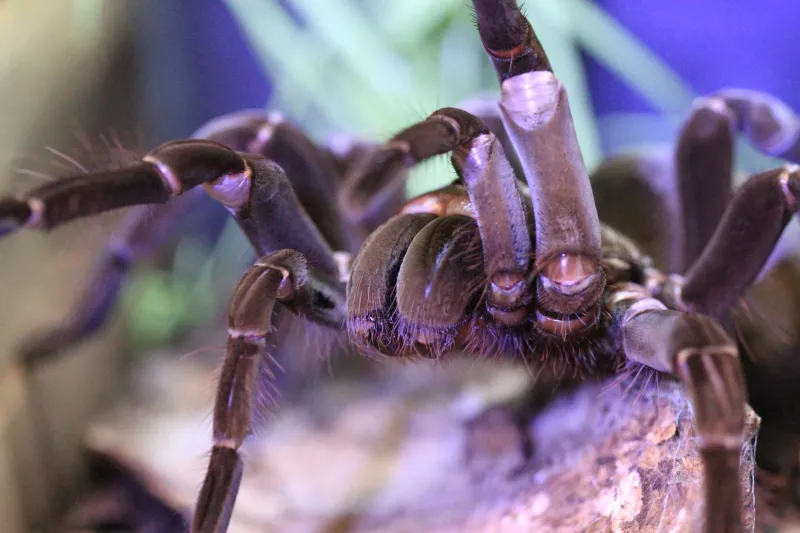
Willed and Watered: Planning a Brachypelma Collection's Future Beyond the Keeper
Most writing on tarantula husbandry proceeds from a single comfortable assumption: that the keeper is present. The enclosure is misted, the dish is filled, the moult is logged, and the whole arrangement is sustained by one person's attention. What is far less frequently discussed is the arrangement that replaces that attention when the keeper dies, is hospitalised, or otherwise becomes unable to open the cabinet door.
This is not a sentimental topic, and it should not be treated as one. It is the final line of a care sheet. A collection that has been kept well for a decade can be undone in a fortnight by an unrecorded routine, and the responsibility for that gap sits with the keeper, not with the relatives who did not know what a Brachypelma hamorii was until they had to.
The gap between intention and instruction
Almost every long-standing keeper has a rough intention: someone will take them, the shop will take them, the society will sort something out. Intentions of this kind are not plans. They are unrecorded assumptions held by a single person, and they fail at precisely the moment they are needed.
The timescale matters here, and it is often misjudged. A Brachypelma in a well-ventilated enclosure with a full water dish will not perish in a week of neglect. It may not perish in three. But a shelf of spiders in a heated room in February, unattended for six weeks, with a household that has turned the thermostat down and closed the curtains, is a different proposition altogether. Any legacy plan therefore needs a timescale attached to it, not merely a name.
A single sheet for the first seventy-two hours
The most useful document in this whole exercise is one page long. It is not a will, it is not a dossier, and it should not require any prior knowledge of arachnology to act upon.
It should state, in plain English:
- Who to telephone first, and who to telephone if that person cannot be reached.
- Where the enclosure keys, spare water bottles and feeder supply are kept.
- Which enclosures hold which spiders, described by appearance as well as by name — "the dark one in the middle shelf, not the orange one" — because labels mean nothing to a newcomer.
- Which spiders are in pre-moult and must not be disturbed, handled or fed.
- The water routine, in days of the week rather than in humidity percentages.
- A clear instruction not to feed unless told to, since overfeeding by a worried non-keeper is a more common error than neglect.
Laminate it, date it, and keep a copy somewhere obvious: inside the cabinet door, in the drawer beneath the enclosures, and a second copy with the person named on it. A document nobody can find is not a contingency.
The husbandry dossier
The full record belongs in a separate folder, and it should be the same record the keeper already maintains for their own purposes. For each animal: species, sex if known, acquisition date, the location of provenance and CITES paperwork, the moult history, feeding interval, temperament notes, and any veterinary history. Where records are digital, note the file location and how to reach it.
This is where the ordinary discipline of keeping pays a dividend. A keeper who already logs moults and feeds has most of the dossier written. A keeper who does not will find that assembling it in an afternoon is an instructive exercise in how much of their husbandry lives only in their head.
Naming a person rather than a sentiment
The instinct is to choose the family member who likes the spiders most. This is usually the wrong criterion. Choose the person who is reliable, geographically close, and capable of following an instruction without improvising. Then ask them, explicitly, whether they are willing. A named successor who has not been consulted is a hopeful guess.
It is sensible to name two: a primary and a fallback, in the knowledge that circumstances change and that the primary may themselves be unavailable. Where a solicitor is drafting a will, a specific gift clause can address the collection, but the practical instructions are better placed in a separate letter of wishes, which can be revised without the expense and formality of re-executing a will.
The legal scaffolding, briefly
For England and Wales, a lasting power of attorney covering property and financial affairs allows an appointed attorney to deal with the keeper's property during their lifetime, and a tarantula collection is property in law. Scotland uses continuing powers of attorney and Northern Ireland enduring powers of attorney; the principle is the same, and so is the trap. An attorney has the authority but not the knowledge. The schedule attached to the power of attorney is where the knowledge must sit.
It is worth being candid about the limits of statute. There is no duty of care owed to a tarantula under the Animal Welfare Act 2006 in the way there is to a dog or a cat. The obligation described in this article is ethical and practical rather than enforceable, which is precisely why it needs to be written down.
Rehoming routes that will actually answer
A plan is only as good as its second link. Before relying on any route, test it. The British Tarantula Society and its regional membership are an obvious first point of contact. Specialist exotic retailers will often absorb one or two animals, rarely a whole shelf, and rarely in a hurry. Specialist rescues exist and are stretched. Local herpetological societies frequently know a keeper who will help.
The practical question is not "who might take them" but "who has already agreed to". Record that agreement, with a date, alongside the dossier. Bear in mind too that Brachypelma species are CITES Appendix II listed, so the paperwork must travel with the animals; a rehomer who is not told where the Article 10 certificates are is being handed a problem as well as a spider.
Money, modestly
A small sum set aside to cover three months of feeders, electricity and transport is worth more than an elaborate arrangement. It should be described plainly in the letter of wishes: what it is for, and what it is not for.
Conversations with people who do not keep spiders
Nothing in this plan substitutes for a single conversation held in person, in the spider room, with the person who will be responsible. Walk them through the water routine once. Show them which enclosures open and which do not. Let them see that the animals are calm and that the task is small. Most people's fear is of the unknown animal; most people's failure is in the unknown routine.
Review the whole arrangement once a year, alongside the moult register. A legacy plan is not a document written once and filed away; it is a husbandry habit, and like any other, it only works if it is repeated.