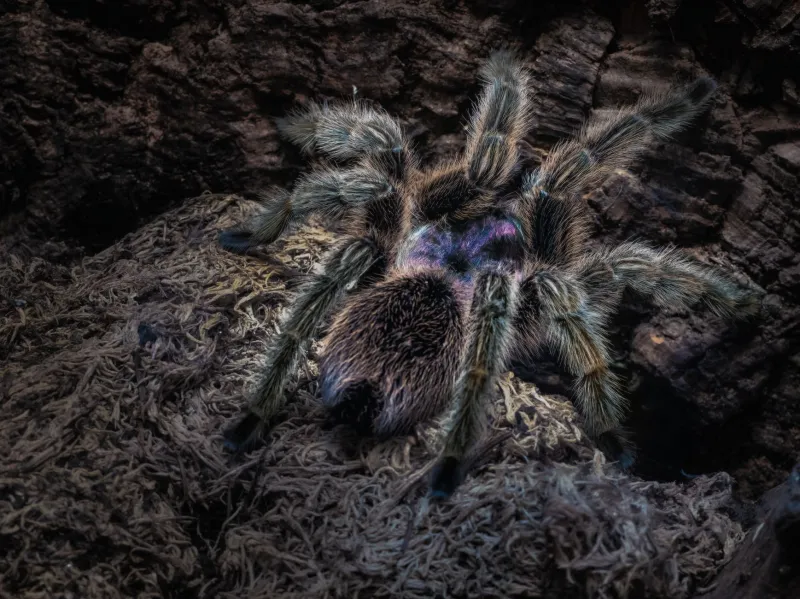
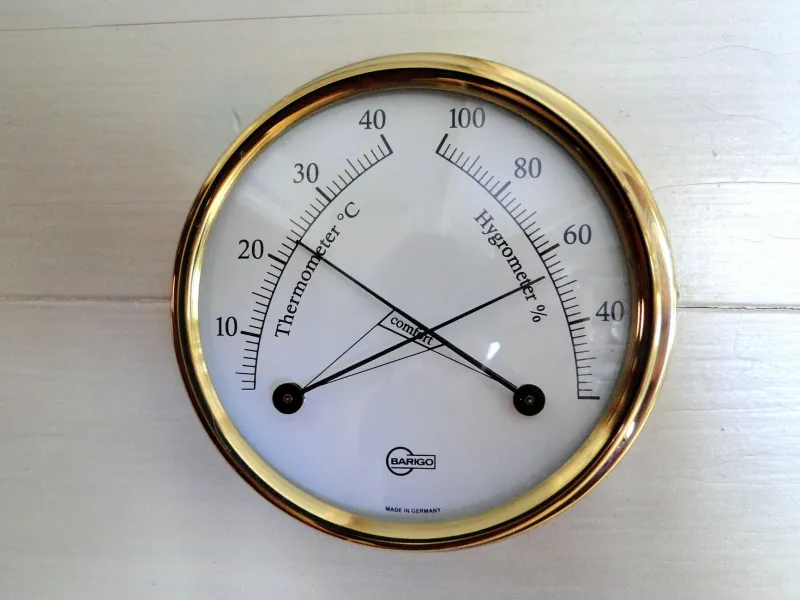
Tremors in the Terrarium: A Vibration Audit for the Brachypelma Room
Tarantula care is often discussed as a set of visible variables: temperature, humidity, substrate depth, the position of a water dish. Vibration is less visible, but it is not less real. A captive Brachypelma lives on a shelf that may also carry the shudder of a washing machine's spin cycle, the thud of a closing door, or the low pulse of a neighbour's bass. For a mainly sit-and-wait animal, these signals are not merely background noise. They are information, and sometimes they are disturbance.
What the spider is actually sensing
A tarantula does not hear in the human sense. It reads the world through mechanosensation. Fine hairs called trichobothria detect air movement, while slit sensilla and associated lyriform organs in the exoskeleton respond to strains and substrate-borne vibration. The result is a animal exquisitely tuned to small movements: a cricket crossing the substrate, a predator approaching, a sudden shift in the environment. In a domestic room, the same systems that make a Brachypelma an effective ambush predator also make it a receiver for the household's mechanical life.
This matters because vibration is not a single phenomenon. A washing machine on spin may transmit a steady low-frequency hum through a timber floor. A door slamming sends a sharper broadband jolt through walls and shelves. Footsteps produce repeated impacts, and a nearby subwoofer can fill a room with low-frequency energy that is felt rather than heard. The spider does not need to identify the source. It only needs to register that the surface beneath it has changed.
A simple audit, before any spending
The first step is not to buy acoustic foam or rebuild the spider room. It is to establish a baseline. Choose two or three ordinary periods: a weekday evening, a weekend morning, and a time when the household is usually quiet. Sit in the room and note what runs. Listen for the fridge compressor, the central-heating pump, the boiler, the washing machine, the extractor fan, and any music or television that carries bass. Then place a half-filled glass of water on the shelf beside the enclosure and watch the surface during each event. Ripples are not a precise measurement, but they are a useful indication that the shelf is receiving movement.
Repeat the exercise with a fingertip resting lightly on the shelf and on the wall behind it. Note whether the vibration is constant, intermittent or sudden. A continuous low hum and a sharp door thud require different responses. Keep a short diary for a week. The aim is not to turn a living room into a laboratory, but to replace guesswork with a few honest observations.
The usual culprits in British homes
In flats and Victorian conversions, suspended timber floors are efficient transmitters. A washing machine in a neighbouring kitchen, or even in the same flat but on a different floor, can send a regular pulse through the structure. Party walls carry impact noise from doors and cupboards. In terraces and semi-detached houses, shared walls and adjoining floors can transmit vibration from next door without any audible sound in the spider room itself. Detached houses are not immune: a boiler pump, a fridge, a tumble dryer or a heavy external door can all put energy into the fabric of the room.
Traffic is less controllable. Lorries and buses produce low-frequency road vibration that may be felt more than heard, particularly in older properties close to a main road. Music is another common source. A subwoofer placed on the same shelf as an enclosure is an obvious problem, but even a television on a shared unit can introduce a steady bass component. The keeper's task is to rank these sources by regularity and intensity, not to eliminate every last tremor.
Placement matters more than padding
The most effective intervention is usually relocation. An enclosure sitting directly on a washing machine, tumble dryer or speaker is poorly placed by definition. So is one fixed to a shared party wall that receives regular impact noise, or placed on a flexible shelf that rocks when a door closes. A solid shelf on an internal wall, away from appliances and doorways, is generally a better starting point. In rented accommodation, where drilling is not an option, freestanding shelving can still be moved a few centimetres away from the wall and away from the busiest traffic routes through the room.
Where some transmission remains, modest decoupling may help. Closed-cell foam or cork pads under the feet of a shelf can reduce the transfer of vibration into the furniture, provided the shelf remains stable. Thick open-cell foam placed directly under a glass enclosure is less helpful: it may allow the enclosure to rock, and a moving enclosure is worse than a vibrating one. The principle is stability first, isolation second. The spider room should not be made silent at the cost of ventilation, heat control or safe access.
Reducing the worst of it without over-engineering
Practical measures should be proportionate. Balance washing-machine loads and avoid the highest spin setting where the machine is close to the spider room. Fit soft-close buffers to doors that slam, and use felt pads or rubber feet on furniture that transmits knocks. Keep speakers off the same surface as enclosures. If a boiler or pump runs loudly through the night, ask a technician whether it is operating correctly; the answer may be maintenance rather than exotic husbandry. Heavy rugs and curtains can soften some airborne sound, though their effect on structural vibration is limited.
It is equally important not to overcorrect. Moving a Brachypelma into a sealed cupboard to escape noise may create stagnant air and unstable temperatures. Wrapping an enclosure in foam may reduce ventilation. Chasing a perfectly still room is neither realistic nor necessary. A well-placed enclosure in an ordinary home, with the worst intermittent shocks reduced, is a reasonable standard.
Reading the spider's response
Vibration becomes a welfare concern when it changes behaviour persistently. A spider that retreats during a spin cycle and then resumes normal activity is behaving sensibly. A spider that remains hidden for days, refuses food repeatedly, or shows a sustained change in activity after a new appliance or shelf is introduced deserves a review of the environment. Compare the animal with its own baseline rather than with a general rule. Moult, season and acclimatisation also affect behaviour, so vibration should be considered alongside temperature, feeding and husbandry records.
In 2026, the domestic spider room is full of machines that previous generations of keepers did not have to consider in the same way. The answer is not to treat the home as a hostile environment, but to audit it honestly. A Brachypelma does not require silence. It requires predictability, stability and a keeper who notices when the shelf beneath it is telling a different story.