Choice, Cover and Quiet: What Enrichment Can Reasonably Mean for a Captive Brachypelma
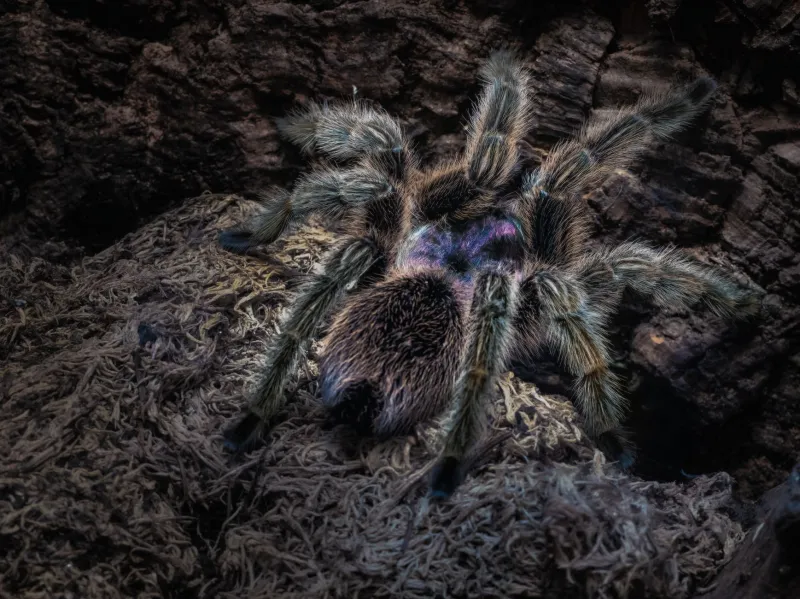
Enrichment has become a familiar word in animal husbandry, but it arrives in the spider room carrying assumptions from mammals. A dog benefits from puzzles, novelty and social contact; a Brachypelma does not experience the world in the same register. For UK keepers in 2026, the useful question is not whether an enclosure looks stimulating to the human eye, but whether it allows the spider to express ordinary behaviours with a measure of choice and security. That distinction matters. It separates functional husbandry from ornament, and it keeps care decisions anchored to evidence rather than to the aesthetic preferences of the keeper.
What enrichment is not
Enrichment is not the same as decoration. A plastic plant, a modelled skull or a brightly coloured water bowl may make an enclosure more agreeable to look at, but none of these necessarily gives a tarantula anything to do, avoid or choose. Nor is enrichment a licence for frequent handling, rearranging or interference. For a largely sedentary ambush predator, novelty is not automatically beneficial; unnecessary disturbance can be a cost. The term is also not a moral score. An enclosure with fewer objects is not thereby worse, and an enclosure crowded with features is not thereby better. The relevant test is whether the animal can perform key behaviours without hazard.
The behaviours worth supporting
A captive Brachypelma cannot be given the full range of a wild existence, but several behaviours are practical to support. Burrowing and retreat use are central for many species in the genus. So are local movement between slightly different microclimates, the ability to withdraw from light and disturbance, and the normal sequence of prey capture. In the wild, Brachypelma are associated with burrows, root cavities, leaf litter and other ground-level cover. Captive provision cannot replicate that precisely, but it can offer analogues: depth for digging, a stable retreat, a moisture gradient and a measure of quiet.
The evidence base here is modest. Invertebrate welfare science is developing, but it does not yet provide a tidy list of enrichment items with proven benefits for every tarantula species. Keepers should therefore be cautious about strong claims in either direction. It is reasonable to say that an enclosure should afford naturalistic behaviour and reduce chronic stressors. It is less reasonable to claim that a particular cork bark arrangement will make a spider happier in any measurable sense. Observations in the home collection are useful, but they are not controlled experiments.
Deeper substrate as functional provision
For a Brachypelma, substrate depth is one of the most defensible forms of enrichment because it supports a behaviour the animal is already inclined to perform. A shallow layer may be hygienic and easy to inspect, but it removes the possibility of digging. A deeper layer of a suitable substrate allows the spider to construct or extend a retreat, and it provides a buffer against rapid moisture loss. In UK rooms, where central heating can dry the air, that buffer is not a trivial matter.
Depth should be considered alongside stability. Loose, dry substrate that collapses immediately offers little. A substrate that holds a burrow without becoming waterlogged is more useful. UK keepers have access to coir, peat-free mixes and other prepared substrates, but whatever is used should be free of fertiliser, pesticides and sharp debris. The aim is not to prescribe a single recipe. It is to give the spider material that behaves sensibly and can be monitored. A useful rule is to provide enough depth for a retreat to be enclosed rather than merely scratched out, while leaving the keeper able to inspect for mould, uneaten prey and stagnant moisture.
Retreat choice and burrow structure
A hide is not simply a place for the spider to sit. It is a structure that affects humidity, light exposure and perceived security. A half-round piece of cork bark, partly buried and angled downwards, can function as a starter burrow. So can a suitably prepared section of bark or a stable hollow that does not trap water. The point is to offer cover that the spider can modify or abandon. Multiple retreats are sometimes advocated, and they can provide choice between drier and damper zones. They can also clutter the enclosure and make observation harder. For most keepers, one well-placed retreat plus deep substrate is a more honest starting point than a miniature landscape of unused objects.
Retreats should be stable, free of sharp edges and accessible for cleaning. A hide that cannot be inspected is a risk, not a benefit. The same applies to buried structures that may become sodden. The keeper should be able to see whether the retreat is dry, damp or stagnant, and should be able to remove it without demolishing the entire enclosure. Good enrichment is not only what the spider can use; it is what the keeper can maintain.
Controlled environmental variation
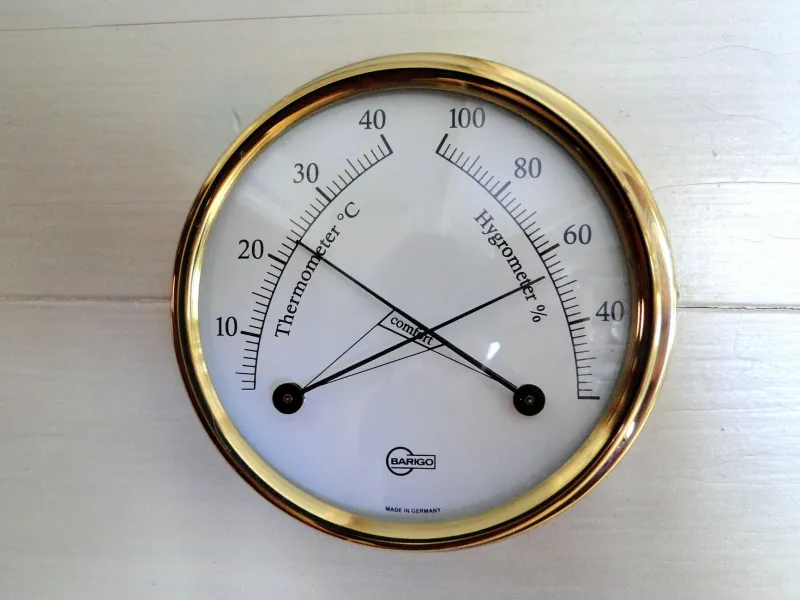
Enrichment can also be environmental rather than physical. A modest gradient across the enclosure, rather than a uniform set of readings, gives a spider the chance to choose a slightly warmer or cooler position, or a drier or damper retreat. This is particularly relevant in British homes, where room conditions can shift with the heating schedule and the weather. The aim is not dramatic fluctuation. It is controlled variation within safe limits, supported by thermometers and hygrometers that are checked rather than assumed.
Light is part of the same picture. A Brachypelma does not need a brightly lit display, and constant illumination may reduce the usefulness of retreats. A quiet corner with cover and a normal room light cycle is generally more defensible than a spotlighted setup. Seasonal change should be handled carefully and through established husbandry routines, not through abrupt experimentation.
The decoration trap
Many products sold for reptile and invertebrate enclosures are decorative first and functional second. That does not make them harmful, but it does mean they should not be counted as enrichment without a reason. Artificial plants may provide cover if they are dense and stable; they may also collect dust and obscure inspection. Ornaments can create sharp edges, trap moisture or fall onto the spider. Natural materials gathered from the garden are especially risky unless the keeper is certain about pesticide exposure and sterilisation. In a UK context, where garden chemicals and damp conditions are common, caution is warranted.
A practical framework helps. Before adding anything, ask what behaviour it permits, what risk it introduces and whether it can be monitored. If the answer to the first question is nothing, the object is decoration. If the answer to the second question is unclear, it should be left out. If the answer to the third is no, it should be redesigned.
A realistic standard
For captive Brachypelma, enrichment is best understood as the provision of functional choice: enough substrate to burrow, a secure retreat, a sensible moisture and temperature gradient, and freedom from unnecessary disturbance. These are modest aims, but they are more meaningful than a visually busy enclosure. Keepers should change one variable at a time, keep notes and be willing to remove additions that produce no benefit or create maintenance problems. In 2026, the responsible standard is not an elaborate spider room. It is a carefully observed one.