Unplugged: A Calm Blackout Protocol for the Brachypelma Shelf
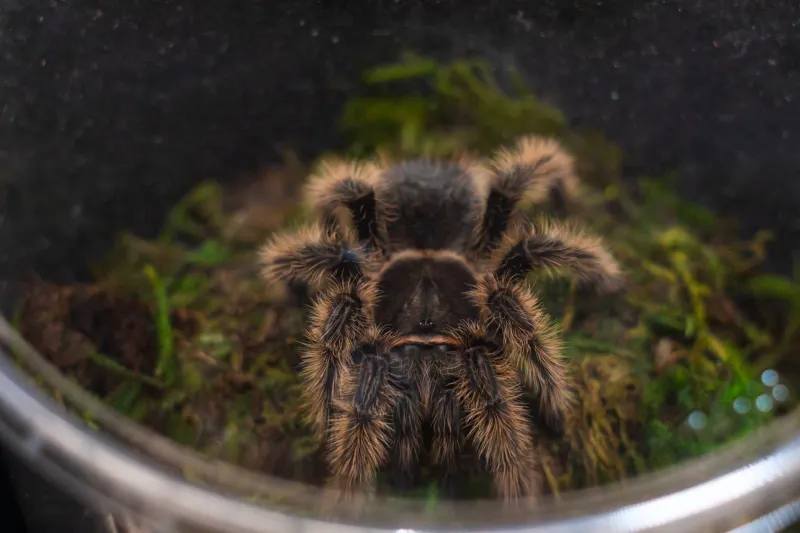
A power cut in a British home is usually an inconvenience measured in hours, not days. For a Brachypelma keeper, however, the mains supply is a quiet partner in husbandry: it runs the heat mat, the room heater, the timer, and the thermostat that keeps a shelf of Mexican tarantulas within a familiar band. When that partner fails, the correct response is not panic but a sequence. The following protocol is written for the ordinary domestic collection—a handful of enclosures in a spare room or living corner—and assumes no generator, no battery backup, and no wish to turn a blackout into an improvisation.
First Ten Minutes: Confirm, Contain, Communicate
Establish the scope before opening any enclosure. Check whether the outage is confined to your property, your street, or a wider area; the local distribution network operator's website or automated line will usually say. If the fault is internal—a tripped circuit breaker, a failed fuse—address it only if you are competent to do so. Otherwise, leave the consumer unit alone.
Contain the collection by closing the door of the spider room. This preserves residual heat and limits draughts. Do not open enclosures to check on animals; a Brachypelma at rest does not need reassurance, and every opening releases warm, humid air. If you must inspect, use a torch with a red filter and keep the beam brief.
Communicate early. A household communication card—laminated and kept beside the enclosures—should list the keeper's mobile number, the name and number of a second informed person, the collection inventory, and a single instruction: do not feed, do not open, do not move unless told. In a shared house, this card prevents well-meaning flatmates from 'helping' with a heat mat or a water bowl.
Heat Sources and Their Failure Modes
Most Brachypelma keepers in the UK rely on one of three heat sources: a heat mat under or beside the enclosure, a thermostatically controlled room heater, or ambient central heating. Each fails differently.
A heat mat without a thermostat is a liability in normal operation and a question mark in a blackout. When the power fails, it simply stops. The risk arises on restoration: a mat that was switched on at the wall may come back to life while the thermostat is still rebooting, or a timer may have reset to 'on' at an unsafe hour. The protocol is therefore to unplug heat mats at the wall during the outage, if safe to do so, and to reintroduce them only after the thermostat and timer have been checked.
Room heaters and central heating are usually more stable. A gas boiler may continue to fire during an electricity cut if it has a battery-free pilot, but most modern boilers need mains power for pumps and controls. Assume no central heating. The room will drift toward the outdoor temperature, but a well-insulated British home loses heat slowly over the first few hours.
Room-Temperature Triage by Species
Brachypelma species are not fragile in the way that some tropical arboreals are. They come from seasonally dry and variable habitats in Mexico and Central America, and most adults will tolerate a short drop to 16–18°C without distress. The priorities are not species alone but life stage and recent history.
Slings and small juveniles lose heat and moisture faster than adults. A 2 cm Brachypelma sling in a small deli cup has little thermal mass; it should be moved first to the warmest safe room, wrapped in a towel, and left undisturbed. Freshly moulted animals, still soft and pale, are likewise a priority: they are not to be handled or moved unnecessarily, but their enclosures should be grouped in the warmest zone. A gravid female approaching a sac is also worth watching, though moving her is rarely wise.
Among adults, the robust species—Brachypelma hamorii, B. smithi, B. emilia—can be left in a room that stays above 15°C for twelve to twenty-four hours with little risk. B. boehmei and B. auratum are similarly hardy in the hobby. The more delicate proposition is any animal that has recently been posted, rehoused, or treated for dehydration; these should be treated as slings for the purpose of triage.
Insulation Without Risk
Insulation is the keeper's main passive tool. Blankets, towels, cardboard, or bubble wrap can be draped over and around enclosures, but ventilation must remain. Never seal an enclosure completely; a Brachypelma needs airflow, and condensation is more dangerous than cool air. The aim is to slow heat loss, not to create a sealed box.
Group enclosures together in the smallest room available, ideally one with external walls that are well insulated and no large windows. A downstairs cloakroom or an internal bathroom often works better than a living room with a bay window. Keep the door closed and block draughts at the base with a rolled towel.
Do not introduce open flame, camping stoves, or unvented gas heaters into the spider room. Chemical heat packs can be used with extreme caution: place them outside the enclosure, never in direct contact, and monitor temperature with a thermometer. A heat pack that reaches 40°C will do more harm than a room at 16°C.
The Timer Reset and Equipment Check
When the power returns, resist the urge to restore everything at once. First, check the consumer unit and any RCDs. Then inspect heat mats and cables for visible damage—rodent chew, moisture, or scorching—before plugging anything back in. Reset timers to the correct time and confirm that thermostats are reading accurately with a separate thermometer.
Bring temperatures up gradually over several hours. A sudden jump from 15°C to 28°C is more stressful than a slow return to 24°C. Observe each animal from outside the enclosure: look for normal posture, not lethargy or curling. Record the outage in your husbandry log, noting duration, minimum room temperature, and any equipment reset. This record is useful for patterns—if the same circuit trips each winter, the fault is worth fixing.
The Dark-Hours Checklist
- Confirm the outage and its likely duration.
- Close the spider-room door; block draughts.
- Do not open enclosures unless absolutely necessary.
- Unplug heat mats at the wall if safe.
- Move slings and freshly moulted animals to the warmest safe room.
- Insulate with breathable covers, leaving ventilation.
- Place the household communication card where others can see it.
- Avoid open flame and unvented heaters in the spider room.
- Record minimum temperature and outage duration.
- On restoration, check equipment before resetting timers and thermostats.
After the Lights Return
A blackout is a stress test, not a verdict. Most Brachypelma collections will come through a short cut with nothing more than a cool night and a reset clock. The value of the protocol is that it replaces improvisation with a sequence, and it gives a non-keeper household a clear, calm instruction. Keep the card current, keep a torch and a thermometer where you can find them in the dark, and treat the next outage as a drill rather than a disaster.